MAURI FRIENDS!
‘MAURI’ IS HOW YOU SAY ‘HELLO’ IN KIRIBATI.

PREPARE FOR YOUR ISLAND ADVENTURE!

-
Did you hear how Marita pronounced the name of Kiribati? Did it sound how you thought it would? How did you think it would sound?
As you’ll soon discover, the Kiribati alphabet is a little bit different to the English alphabet.
One of those differences is that the ‘ti’ sound is pronounced as an ‘s’.
So even though when you look at it, you might want to say ki-ree-bah-ti - the correct way to say it is Ki-ree-bas.
You might like to practise that together.

WHERE IS KIRIBATI?
The nation of Kiribati is located in the middle of the Pacific Ocean. The Pacific is divided into Micronesia, Polynesia and Melanesia, and Kiribati is part of Micronesia.
As a class, in smaller groups or individually use a globe, wall map or digital application such as Google Earth to find:
the Pacific Islands
Kiribati within Micronesia
how far away your school is from Kiribati


WHY ARE THERE HOLES IN THE ISLANDS OF KIRIBATI?
Did you notice anything interesting about the shape of the islands?
Kiribati is made up of 32 atolls, and 1 raised island.
An atoll is a ring-shaped island, that has formed on the top of an extinct volcano. The rim of the island encircles a lagoon.
The ocean that surrounds the atoll is dark blue and has waves.
The lagoon in the middle is usually bright turquoise and is a little calmer.
Watch the video below to see the difference between the Lagoon and the Ocean.

WHAT DOES KIRIBATI LOOK & SOUND LIKE?
-
Themes: We are surrounded by the ocean; All together now
Watch the video that Marita created of her time in Kiribati. While watching the video, play the game, “See it! Hear it!”
When you see something you recognise, put up your hand and identify what you have seen and explain the sound you think it would make.
For example: Sand / Ocean / Lagoon / Coconut trees
As a class, write a list using one word or short phrases to share personal memories of:
Being in hot and/or humid weather
The beach
Smelling fragrant flowers like a frangipani
Fishing
Use a selection of the words and short phrases to create a class sensory poem that conveys the sights and sounds of being in hot weather by the ocean.
Speak the poem together, or each take a line to say. Experiment with different voices to depict the mood and feeling of the words within the poem.
Add movement to each line of the poem, so the poem becomes a celebration of voice and movement!
Share your poem with a neighbouring classroom.
CURRICULUM LINKS:
English: AC9E1LA04 Explore how repetition, rhyme and rhythm create cohesion in simple poems, chants and songs
AC9E1LA07 Understand that words can represent people, places and things (nouns, including pronouns), happenings and states (verbs), qualities (adjectives) and details such as when, were and how (adverbs)
AC9E1LY06 Create and re-read to edit short written and/or multimodal texts to report on a topic, express an opinion or recount a real or imagined event, using grammatically correct simple sentences, some topic-specific vocabulary, sentence boundary punctuation and correct spelling of some one- and two-syllable words
AC9E2LA04 Understand how texts are made cohesive by using personal and possessive pronouns and by omitting words that can be inferred
AC9E2LE04 Identify, reproduce and experiment with rhythmic sound and word patterns in poems, chants, rhymes and songs
AC9E2LE05 Create and edit literary texts by adapting structures and language features of familiar literary texts through drawing, writing, performance and digital tools
AC9E2LY06 Create and edit short imaginative, informative and persuasive written and/or multimodal texts for familiar audiences, using text structure appropriate to purpose, simple and compound sentences, noun groups and verb groups, topic-specific vocabulary, simple punctuation and common 2-syllable words
The Arts / Drama: AC9ADR2C01 Create and co-create fictional situations based on imagination and/or experience
AC9ADR2P01 Share their drama in informal settings
-
Themes: All together now
Play the game ‘Marita Says’ (a Kiribati inspired version of Simon Says).
Find a space in the room where everyone is safe to move on their spot.
Practise being:
A coconut (crouch down in a round ball)
An atoll (standing up, make an irregular shape with your body)
A palm tree (stand tall and put your arms above your head like palm tree fronds blowing in the wind)
Teacher or class member takes on the role of Marita. When they call, “Marita Says be a coconut/atoll/palm tree” everyone moves into that position.
If they call, “Be a coconut/atoll/palm tree” (without saying Marita Says) and you move into that position, you are out!
At the end of the game, you might like to say ‘Ti a konna’ (pronounced Sah - kor - nah) which means ‘all together’ to start the game over again.
CURRICULUM LINKS:
The Arts / Drama: AC9DR2D01 Use the elements of drama and imagination in dramatic play and/or process drama
-
Themes: We use the things we have in reach; We are surrounded by the ocean; All together now
To represent the 32 atolls that make up Kiribati:
»Look at these aerial images« of the atolls and islands of Kiribati to see how each atoll is a different shape
Use materials available in the classroom or brought in from home such as cellophane and tissue paper to cut the different shapes of the atolls and create the ring around each atoll
Given the number of atolls in Kiribati, each class member could be given an atoll to create
Share with your table members your choice and use of materials to create the atoll
Display the atolls in the classroom to create a physical representation of Kiribati.
CURRICULUM LINKS:
HASS
1 AC9HS1K03 The natural, managed and constructed features of local places, and their location
Design and Technologies
2 AC9TDE2P02 Use materials, components, tools, equipment and techniques to safely make designed solutions
The Arts / Visual Arts
AC9AVA2C01 Use visual conventions, visual art processes and materials to create artworks

WHAT DOES KIRIBATI TASTE & SMELL LIKE?
-
Theme: We use the things we have in reach
There are lots of coconut trees in Kiribati and people in Kiribati use coconuts in lots of ways including:
using coconut fibre to make strong string to hold together buildings and canoes
food and drink
leaves and trunks for houses and shelter
clothing and jewellery
water bottles and drinking containers
To see a video of coconut string being made <CLICK HERE>
Has anyone seen a coconut, a coconut tree or tasted coconut and/or coconut water, milk or cream?
What did it look, feel or taste like?
Depending on availability and allergies considered, look at and/or taste a coconut and its products such as:
a fresh coconut
coconut water, milk, cream or flesh
desiccated or flaked coconut
Discuss the taste, texture and smell.
Discuss how people in Kiribati might collect coconuts from the tree and break open the hard coconut shell.
You might have seen a clue in the video above!
CURRICULUM LINKS:
Science: AC9S2U03 Recognise that materials can be changed physically without changing their material composition and explore the effect of different actions on materials including bending, twisting, stretching and breaking into smaller pieces
Technologies: AC9TDE2K01 Identify how familiar products, services and environments are designed and produced by people to meet personal or local community needs and sustainability
AC9TDE2K03 Explore how plants and animals are grown for food, clothing and shelter
-
Themes: We use the things we have in reach
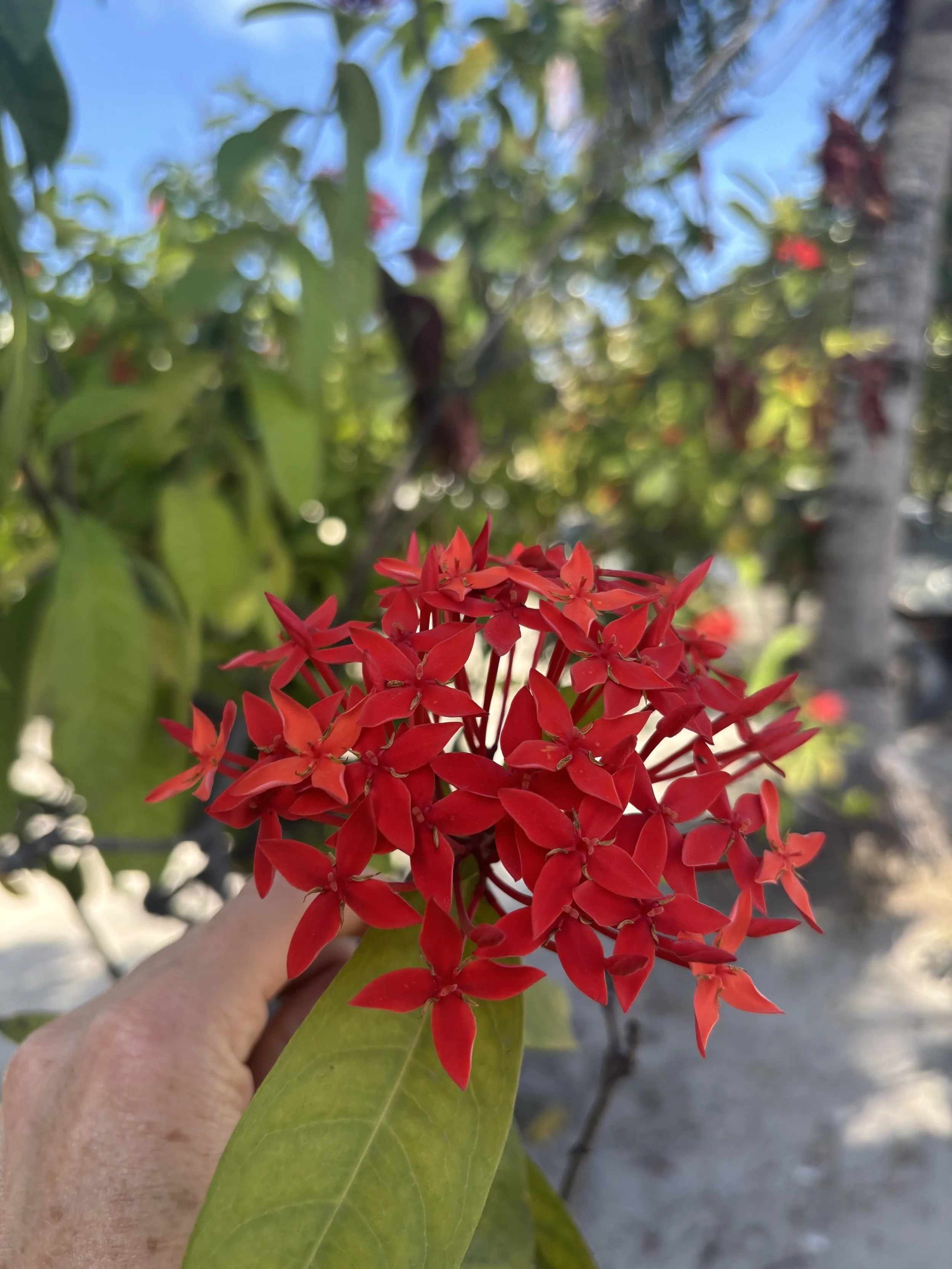
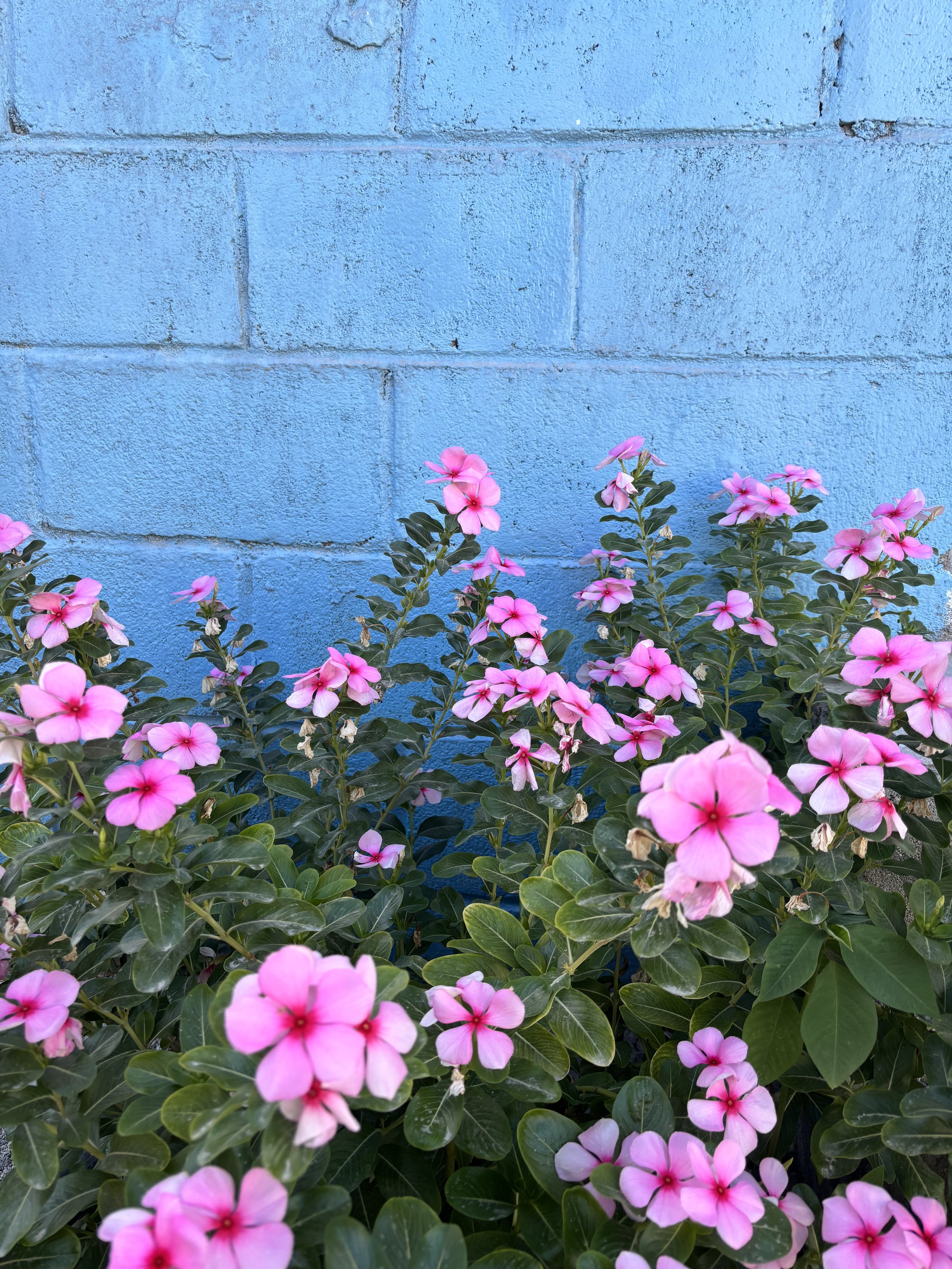
Bright and fragrant flowers are everywhere in Kiribati, making Kiribati smell and look beautiful like in these pictures which were taken when Marita visited Kiribati.
Can you identify any of the flowers?
Using the provided templates of the frangipani flowers and the visual arts materials available to you, colour and cut out the flowers.
Gather the frangipani flowers together - you might like to put them in a basket or container, as they will be used as ‘gifts’ later in the audio experience
CURRICULUM LINKS:
Visual Art: AC9AVA2D01 Experiement and play with visual conventions, visual arts processes and materials
AC9AVA2C01 Use visual conventions, visual arts processes and materials to create artworks
AC9AVA2P01 Share artworks and/or visual arts practice in informal settings


EPISODE ONE:
AN ISLAND ADVENTURE!
Introduction to te katabwanin (going around the island).
Read through the learning experience below for more information on setting up the Compass Points in your room, and a template for the floral gifts for the Spirits.



WHICH WAY IS WHICH?

-
Theme: We are surrounded by ocean
Look at a real compass or on a digital application:
What is it?
What is it used for?
How does it work?
What does “navigation” mean?
Together or in small groups in the classroom or playground, use a compass to work out which way is north, south, east and west.
Use an acronym such as Never Eat Soggy Weet-bix as an easy way to remember the four directions of the compass.
Surrounded by the ocean, people in Kiribati need to be great navigators and have a clear sense of direction. Instead of using north, south, east and west, they use Lagoon side, South side, Ocean side and North side.
Using the compass points link below, mark the Lagoon, South, Ocean and North sides of your classroom.
CURRICULUM LINKS:
HASS: AC9HS1S05 Draw conclusions and make proposals
AC9HS2S05 Draw conclusions and make proposals
OR FEEL FREE TO CREATE YOUR OWN!

WHAT IS AN ADVENTURE AND WHO ARE YOU GOING WITH?
READY TO MOVE ON TO EPISODE TWO?
CLICK ON THE CRAB!