Welcome to
Mauri
Mauri
Mauri = Hello and Welcome
MAURI.
WELCOME. WE ARE SO GLAD YOU ARE HERE.
Keep reading to learn everything you need to know to complete The Flying Canoe, or you can jump straight down to the episodes and resources for Foundation students HERE.
We know, you know your class better than anyone else, so we invite you to begin exploring the different episodes, and charting your own path through the cross-curricular learning opportunities.
Depending on the make up of your class, you can journey on The Flying Canoe as a whole class group, or you might like to break into smaller groups all listening to the audio at the same time.
We hope you enjoy your time together as you explore Neiko and learn about the Kiribati culture.
Feel free to pause, rewind and replay at any point along the journey!
WHAT WILL YOU NEED FOR YOUR ISLAND ADVENTURE?
A class of adventurers
Paper and pencil
Good speakers
(preferably portable)
Floral gifts for the Spirits
(Episode 1)
A canoe for every 4 - 5 people
(Episode 2)
A companion for the adventure
(Episode 2)
Smart Board or Projector
HEADS UP!
As a class you will also need to create some floral gifts, canoes and a companion for the adventure.
These are included in the resources - so be sure not to skip these activities, as you will need them for your journey.
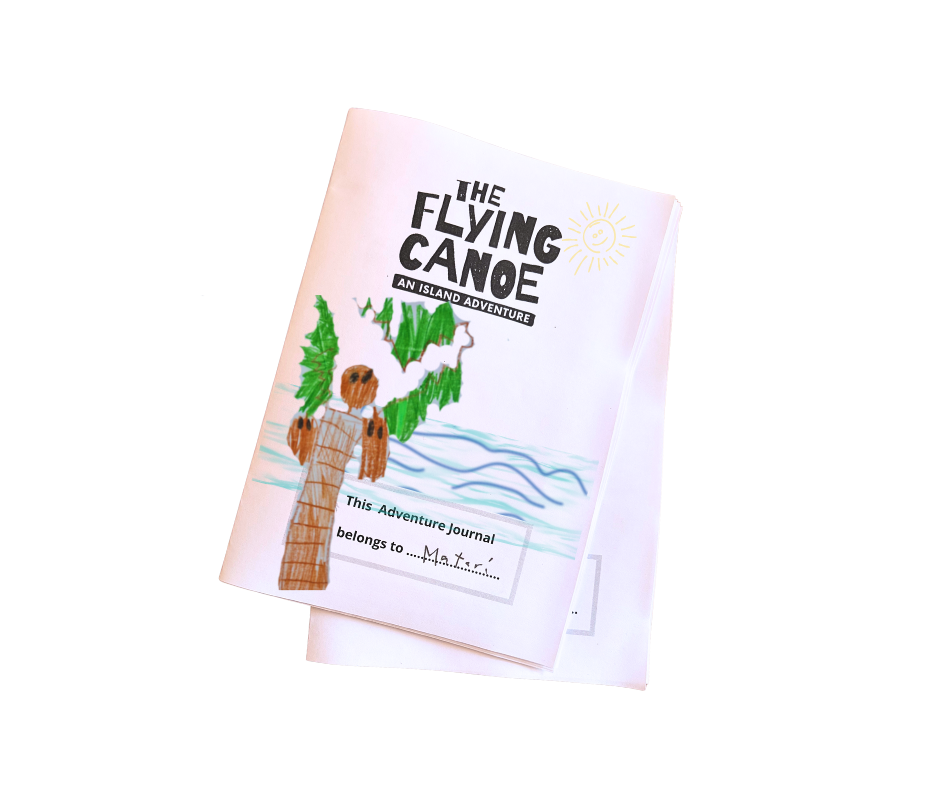
DOWNLOAD THE ADVENTURE JOURNAL FOR YOUR CLASS!
We’ve prepared an Adventure Journal that students can use as they complete the different learning opportunities that accompany each episode of ‘The Flying Canoe’.
ALSO NOTE:
-
‘The Flying Canoe’ is a wonderful way to learn about another culture and it helps us reflect on other cultures that exist in our communities.
While ‘The Flying Canoe’ is a made up story, it has been guided and inspired by many traditional Kiribati stories and people. Great care has been taken to be respectful of Kiribati culture. The creative team has made sure to create an experience that is fun, educational but respectful.
We ask everyone to join in on ‘The Flying Canoe’ journey with love, warmth and joy; bring your curious selves and embrace your introduction to Kiribati culture.
• In Kiribati, the canoe is incredibly important to the family. Of course, you are not building a real canoe, but we encourage you to value your classroom canoes with the same respect, importance and gravitas. It is a valued member of your classroom!
• While the spirit characters in this story are fictional, they are based on real stories that are held to the highest regard in Kiribati. Please encourage your students to listen to them carefully to nurture a feeling of importance.
• When dancing, don’t worry about trying to dance in an ‘islander way’. Just dance with joy!
A resource we encourage teachers to also refer to is Dr Teresia Teaiwa’s The Classroom as a Metaphorical Canoe: Co-operative learning in Pacific Studies. Dr Teaiwa is of Kiribati, Banaban and African American heritage.
While learning about Kiribati culture, it’s great to keep in mind the Indigenous land that you, your students and your classroom sits on.
Dr Terri Janke’s book, True Tracks provides clear guidelines to respectfully incorporate Aboriginal and Torres Strait Island culture and knowledge into your classroom. Janke, T. (2021). True Tracks : Respecting Indigenous Knowledge and Culture (1st ed.). NewSouth Publishing.
-
A big part of Kiribati culture is the belief and respecting of magic and spirits. It is part of the foundation of why Kiribati is so unique and has a rich culture that is still alive today.
For as long as Kiribati has been around, the stories of magic and spirits have been there. These stories and beliefs guide how Kiribati people live, solve problems, find food, create art, music and dance, and also travel safely between atolls.
This magic and the spirits are deeply connected to the land and the ocean. Spirits hold stories and people respect these stories to guide their interaction with the land, ocean, sky and community. The spirits vary from atoll to atoll and when visiting, it is expected that the spirits and custom of that land is respected.
Different kinds of magic is passed down through family members which means that some families specialise in canoe-building magic, while others specialise in song-making magic. There is magic for navigation, love, health, architecture, performance, food and many other things that are part of every day life.
When you put this all together, it forms a community of people who hold special skills and knowledge for different needs as well as ensuring that their interactions with the land, sea and sky are always respectful.
-
Kiribati people live on the frontline of climate change and rising sea levels - however, in the Kiribati language, there is no word for climate change.
Kiribati people live alongside the ocean - reading weather patterns and tides. Being I-Kiribati is about intimately knowing the land you call home and doing all you can to protect it. Culture, family, stories, land, sea and sky are woven together.
As we learn about Kiribati, it is important to understand that the people who live on the frontlines of climate change, are often not the reason for the change of the earth's climate.
Marita has always tried to share stories of Kiribati so that people can learn the culture, traditions and people first. Only then, can we truly connect with the threat of the country disappearing.
‘The Flying Canoe’ doesn't specifically mention climate change because what comes first is a mutual coming together to exchange stories and a deeper understanding of Kiribati.
EPISODES
EPISODE ONE - AN ISLAND ADVENTURE!
EPISODE TWO - THERE’S LAND AHOYA!
EPISODE THREE - STAY TOGETHER, MOVE TOGETHER!
EPISODE FOUR - ROUND AND ROUND AND ROUND WE GO!
EPISODE FIVE - SPIN BLOW THROW…ROW!